
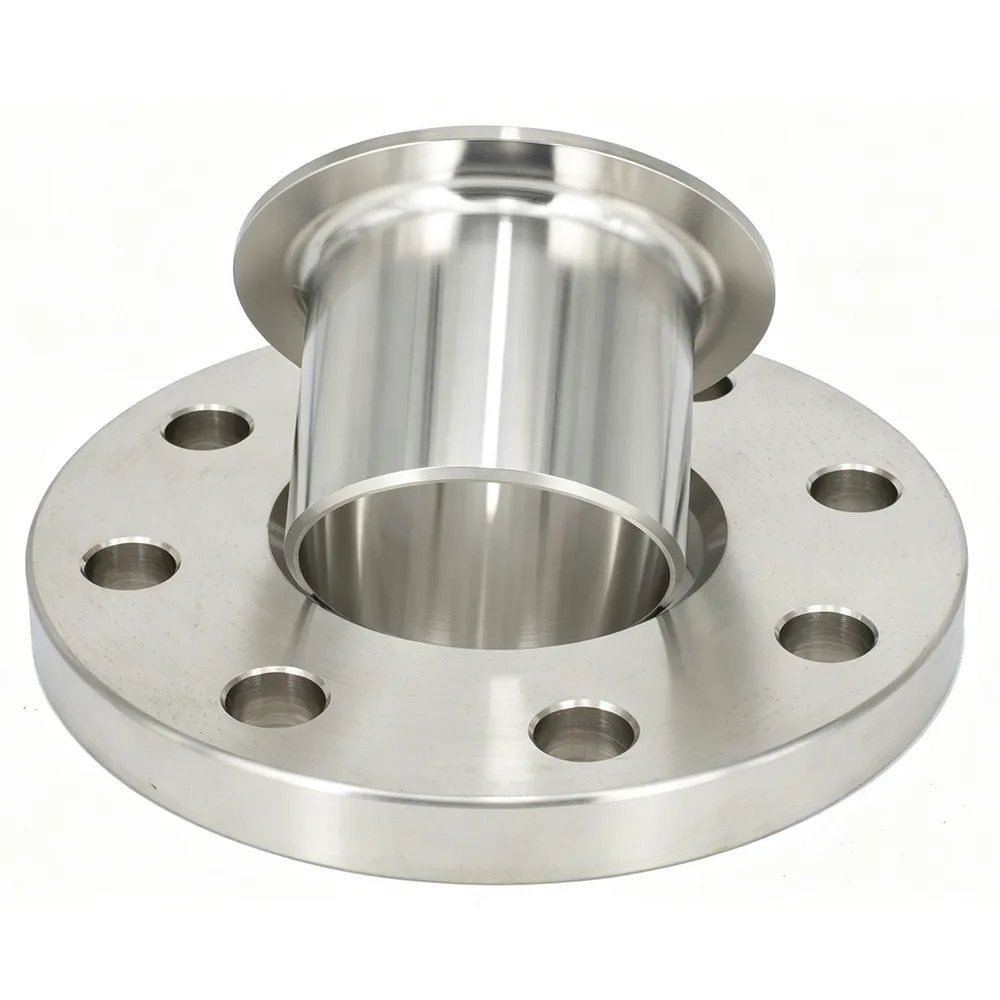
Pipe Flange
Lap Joint Flange (LJ)
Ideal for expensive alloy piping, corrosive service and lines requiring frequent disassembly, such as food & chemical processing.
- Category
- Pipe Flange
- Specification
- RF / with ASME B16.9 stub end / NPS 1/2-24 in
- Product code
- LJ-RF
Product details
When a line built from expensive alloy piping must be opened again and again for inspection and maintenance, every component that touches the process fluid carries the full cost of that alloy. A lap joint flange takes a different route: it keeps the wetted alloy to a minimum and leaves the bolted joint free to move, so the same service can be maintained without paying alloy prices for the whole connection.
Structure and Working Principle
A lap joint flange is used together with a stub end. The flange ring itself is loose and not welded to pipe; only the stub end is butt-welded to pipe. Because the ring is not fixed to the pipe, the loose flange can rotate freely to adjust bolt holes during assembly.
The practical consequence of this arrangement is simple: only the stub end contacts the process fluid, so the part that meets the medium is the part made from the alloy, while the ring behind it is free to be made from a less costly material.
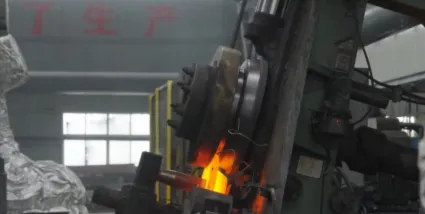
Where a Lap Joint Flange Fits
The lap joint design is chosen where the line is opened often and where the pipe material is costly. Its intended uses, taken from the product definition, are:
- Frequent disassembly & maintenance.
- Expensive alloy piping (titanium, duplex, stainless steel) — only the stub end uses expensive alloy while the flange ring uses carbon steel.
- Large pipe, where the free rotation makes bolt holes easy to align.
- Misalignment installation.
Where It Should Not Be Used
The same loose construction is not suited to every duty. A lap joint flange is not for high vibration. In services with heavy vibration the freedom that makes the joint easy to assemble works against it, and a more rigid flange type should be considered instead.
Available Sealing Faces
The lap joint flange is offered with the following faces:
- RF — Raised Face
- FF — Flat Face
- MFM — Male & Female
- T&G — Tongue & Groove
Applicable Standards
Depending on the project specification, lap joint flanges and their matching stub ends are manufactured to the following standards:
| System | Standards |
|---|---|
| ASME | ASME B16.5, ASME B16.47, Stub End ASME B16.9 |
| EN | EN 1092-1, Stub end EN 10253 |
| GB | GB/T 9120, HG/T 20615 |
| JIS | JIS B2220 |
| GOST | GOST 33259 |
Because the ring and the stub end work as a pair, the stub end standard should always be confirmed together with the flange standard when specifying a lap joint connection.